Building a Read-Only MCP Tool Server: Zero-Trust Enterprise Data Access for Claude, Cursor, and Beyond
How we added a second HTTP interface to our enterprise orchestrator: OAuth at the edge, opaque grants, 120-second delegated JWTs, and the same RBAC as the web app—with no prompt-based security.
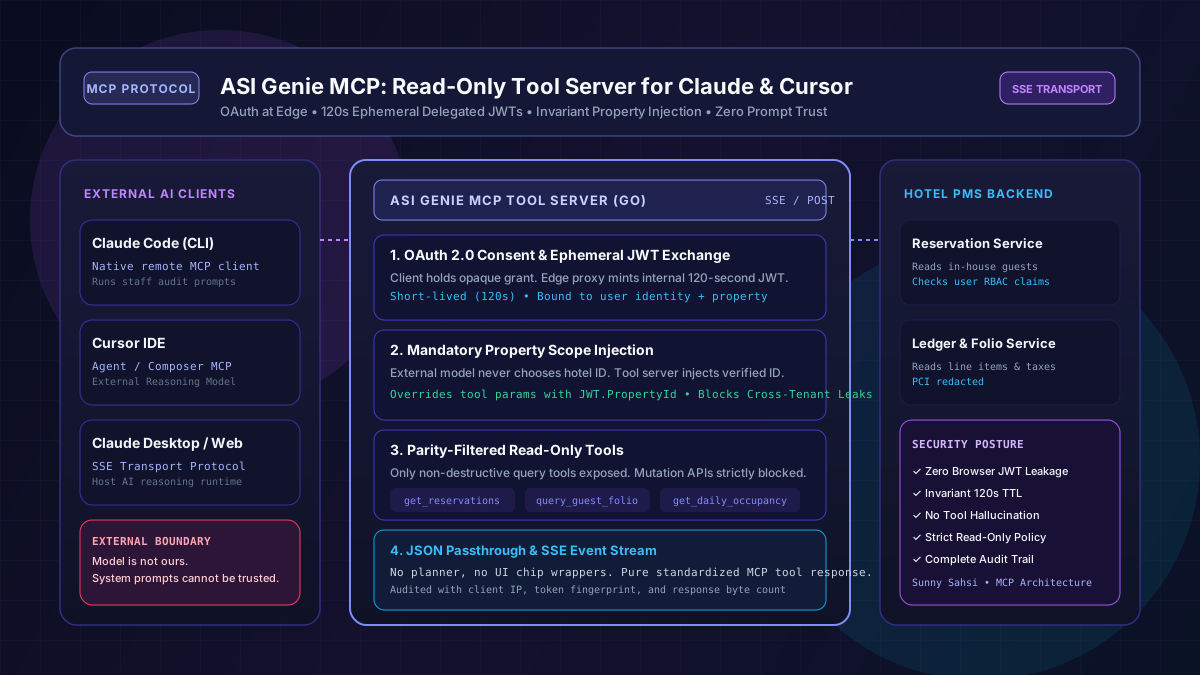
- •Zero-Trust Invariant: Security lives strictly in server-side authorization gates and session token validation—never in LLM prompt instructions.
- •Deterministic Tool Execution: 600+ OpenAPI endpoints are dynamically pruned to domain-specific candidates, eliminating tool hallucinations.
- •Delegated Grants: Scheduled automations run using revocable, scoped grants with tight TTLs without exposing root database credentials.
_Companion to: Inside an Enterprise AI Orchestrator: Multi-Service LLMs, Automation, and Zero-Trust Access_
TL;DR
The in-product chat path owns the model, prompts, and UX. The Model Context Protocol (MCP) path is deliberately different: the orchestrator becomes a tool server—no planner, no present_answer, no chip UX. External clients (e.g. Claude on the web, Claude Code, Cursor remote MCP) bring their own system prompts and reasoning. Security cannot live in instructions; it must live in OAuth consent, token exchange, tool allowlists, mandatory tenant injection, downstream RBAC, rate limits, and audit. v1 is read-only, parity-filtered with interactive chat, with JSON passthrough like the chat executor.
[!TIP] Blueprint & Template Notice: This architecture serves as a generic, production-ready template for exposing internal microservices safely to external MCP clients (Cursor, Claude Desktop, Windsurf) without prompt leakage or privilege escalation. Open-source starter templates are coming soon!
Why a second interface?
Teams already ask questions inside the web application via the in-app assistant. Product also wanted the same enterprise data available where power users already work: AI-native IDEs and assistants that speak MCP.
That sounds like “expose our APIs to Claude.” In a multi-service backend with heterogeneous auth header semantics and no audience on legacy session JWTs, the naive approach fails quickly:
| Naive approach | What breaks |
|---|---|
| Forward the user’s browser JWT to MCP | Long-lived credential leaves the browser trust zone; external client holds it |
| Forward MCP bearer to downstream Service 1 / 2 APIs | Downstream services interpret Authorization differently (M2M vs user) |
Let the model pass tenantId | Cross-tenant data exfiltration via tool arguments |
| Rely on “don’t call admin APIs” in the system prompt | Prompt controls do not apply on MCP—there is no in-house planner |
The MCP design accepts a hard split:
Merit: One orchestrator binary, one tool registry filter, one RBAC story. Demerit: Operators must understand two security postures—chat has prompt-side guardrails; MCP does not.
Physical layout: one process, two HTTP servers
Chat and MCP share Postgres, the generated tool registry, and auth integration—but not the same http.Server tuning:
Illustrative startup gating (pseudocode):
if envBool("MCP_ENABLED") {
    go mcpServer.ListenAndServe() // separate from chat server
}
// MCP_ENABLED=false → port not bound (feature absent, not 403)
Why two servers? Chat streaming fits a bounded write timeout. MCP sessions (Streamable HTTP) can outlive that window; killing the connection mid-session is worse than isolating listeners.
Credential ladder: four layers, two rules
MCP introduces a credential ladder so each hop only means what it should:
| Credential | Holder | Lifetime | Appears on |
|---|---|---|---|
| OAuth code | Client ↔ Auth | Seconds | Token endpoint only |
| MCP access token | External AI client | ~1 hour | Authorization: Bearer on /mcp only |
| Service API key | Orchestrator ↔ Auth | Rotation-managed | Internal exchange only |
| Delegated JWT | Orchestrator memory | ~120 seconds | X-Token on one downstream call |
R1 — Opaque bearer: The MCP access token is meaningless to downstream APIs. Only the identity service’s grant table can interpret it.
R2 — Delegated JWT never egresses: Minted for one downstream call, dropped immediately—never returned to Anthropic, never logged, not cached like introspection.
Illustrative exchange contract (shape only):
{
  "grant_type": "urn:ietf:params:oauth:grant-type:token-exchange",
  "subject_token": "<opaque>",
  "audience": "https://<canonical-mcp-resource-uri>",
  "requested_token_type": "urn:ietf:params:oauth:token-type:jwt"
}
Deliberate absence: No user_id, property_id, or act_as fields on the exchange request—the endpoint cannot become an impersonation oracle.
On success, the identity service returns active, scopes, property_id from the grant, and a short-lived delegated_token. On failure, { "active": false } without distinguishing _why_—mitigating token enumeration.
OAuth and consent: property on the consent screen
Product-locked v1 behavior:
| Requirement | Behavior |
|---|---|
| Read-only | No write tools; same GET filter as chat planner pool (~hundreds of tools, not exact count in public docs) |
| Coarse OAuth scope | e.g. tools:read gates _whether_ MCP attempts reads; RBAC on each route still decides success |
| One active tenant | Default tenantId on grant; answers are for one tenant context like chat |
| Tenant switch | Meta-tool to change active tenant after live permission re-check |
| Data egress | Passthrough JSON like chat execTool—no MCP-only field stripping |
RFC 8707-style resource binding ties tokens to the canonical MCP URI so audience confusion across environments is harder.
One tool call, end to end
Pseudocode for the critical control:
func executeReadTool(principal Principal, tool string, args map[string]any) {
    if !readAllowlist.Contains(tool) {
        return denied("tool_not_exposed")
    }
    args = stripAndInjectProperty(args, principal.PropertyID)
    jwt := principal.DelegatedToken // 120s, single use
    resp := httpGet(tool, jwt, args) // header: X-Token only
    audit(tool, principal, latency, outcome)
    return passthrough(resp)
}
Confused-deputy guard: Downstream calls use X-Token only. Setting Authorization on downstream clients would conflate M2M keys with user sessions across services.
Trust boundaries and prompt injection
| Boundary | What crosses | Control |
|---|---|---|
| User → AI cloud | OAuth grant intent | Consent UI names tenant + client |
| AI → your edge | Opaque bearer, tool args | TLS, optional egress IP allowlist, rate limits |
| Handler → internals | Resolved user, client id, tenant | Introspection + audience check |
| Internals → identity | Subject token only | Service API key, no user impersonation params |
| Internals → data | Short-lived user JWT | RBAC per route, 20s read timeout (v1) |
| Data → AI | Full JSON (passthrough) | Same egress as chat-to-LLM—including PII |
The uncomfortable truth (demerit): The model may read freeform text remarks, operational notes, or any field RBAC allows. An attacker who can influence text the model later reads can attempt indirect prompt injection. MCP mitigation is not “tell Claude to ignore remarks”—it is treat every tool argument as hostile, never trust client-supplied tenant scope, and monitor audit for anomalous tools.
Shared vs separated: architectural comparison
| Concern | Chat `/chat/stream` | MCP `/mcp` | Shared? |
|---|---|---|---|
| Process binary | Yes | Yes | Shared |
| HTTP server instance | Chat listener | MCP listener | Separated |
| Caller authentication | User session JWT | OAuth opaque bearer | Separated |
| Permission authority | Auth service | Same lookups via exchange | Shared |
| Tool surface | Planner picks subset | Full allowed read registry | Shared filter, different exposure |
| Model | In-app configured LLM | Client’s model | Separated |
| Prompt policy | Planner, refuse rules, PCI | None | Separated |
| Downstream credential | User JWT (~hours) | Delegated JWT (~minutes) | Separated |
| Turn audit | Chat tool executions | Dedicated MCP audit table | Separated schema |
| LLM calls inside orchestrator | Yes | No | MCP is not an LLM proxy |
Merit for security reviews: Anything that only existed in prompts does not protect MCP. The checklist shrinks to server-enforced controls.
Demerit for product: Behavior diverges—chat might refuse a phrasing that MCP still retrieves if RBAC allows the underlying GET.
Tool surface and capability registry
v1 registers one capability kind: read_tool.
| Filter layer | What it removes (examples) |
|---|---|
| Method | Non-GET operations |
| Path fragments | Admin, internal routes, export, impersonation, invites |
| Tenant scope | Cross-tenant listings outside active workspace/org |
| Product v1 | All writes |
Chat narrows which reads the planner mentions; MCP lists the full filtered set so the client model can call any read the user’s role already allows—aligned with “show me everything I’m permitted to see.”
Meta-tools (v1):
- •Set active tenant (re-validates permissions).
- •Get session context (active tenant, user attribution for client UX).
Input schemas on read tools are intentionally permissive (additionalProperties) so nested query objects (e.g. report PDF parameters) match chat’s parameter preparation—at the cost of weaker JSON Schema validation at the MCP edge.
Revocation and permission drift
| Event | Worst-case staleness | Behavior |
|---|---|---|
| Grant revoked | Up to ~60s introspection cache | Fail closed on next exchange |
| User deactivated | Cascade revoke grants | active: false |
| Permission removed | Immediate on backend | 403 on specific tool, not global disconnect |
| Chat path permission cache | Longer TTL elsewhere | Not reused for MCP—by design |
Observability and compliance posture
MCP audit table (Orchestrator Postgres) — separate from chat tool_executions so connector activity is attributable:
| Stored (v1) | Not stored (v1) |
|---|---|
| User id/email, property id | Full tool arguments |
| Client id, grant id, scopes | Response bodies |
| Tool names, HTTP path/method | Delegated JWT / JTI |
| Outcome, duration | — |
Exchange events also log in the identity service’s exchange log—pair grant id + timestamps for incidents.
Best-effort inserts: Audit failure does not block the tool result today—ops may require fail-closed audit before prod (checklist item).
Configuration and kill switches (names only)
Representative environment surface—values belong in secrets management, never in docs or git:
MCP_ENABLED=false          # default off; false = listener not bound
MCP_PORT=8091
MCP_CANONICAL_URI=...      # PRM + audience
MCP_CAPABILITIES=read
MCP_INTROSPECTION_CACHE_TTL=60s
MCP_RATE_LIMIT_PER_MINUTE=30
MCP_RATE_LIMIT_PER_HOUR=500
AUTH_SERVICE_API_KEY=...   # secret
AUTH_SERVICE_INTERNAL_BASE_URL=...

# Identity service
MCP_OAUTH_ENABLED=false
MCP_DELEGATED_TOKEN_TTL=120s
MCP_ACCESS_TOKEN_TTL=1h
Official Go MCP SDK on modern Go; Streamable HTTP with stateless requests—identity from Authorization every call.
Merits of this MCP architecture
| Merit | Explanation |
|---|---|
| No second RBAC system | OAuth scopes are coarse; rbacRoutes.json + middleware remain authoritative |
| No service account reads | Every call traces to a staff user who consented |
| Parity with chat reads | Same IsAllowedReadTool filter—security fixes propagate to both surfaces |
| Opaque tokens | Stolen bearer cannot be replayed on downstream APIs directly |
| Short delegated JWT | Blast radius of a mishandled downstream credential is two minutes |
| Kill switch default off | MCP_ENABLED absent/false means no listener—not a soft 403 |
| Extensible capability registry | Future writes/events add kinds + scopes without new binaries |
| Dual server isolation | Streaming/chat timeouts do not break MCP sessions |
| Audit attribution | grant id + client id distinguish Claude Code vs claude.ai vs Cursor |
| Exchange re-checks live permissions | Grants cannot outlive access removal (modulo cache) |
Demerits, risks, and honest tradeoffs
| Demerit | Impact | Notes / mitigations |
|---|---|---|
| Passthrough egress | External models receive same PII/finance JSON as internal LLM | Rejected MCP-only redaction; compliance must treat AI vendor as subprocessors |
| No prompt layer | No PCI mask, refuse, or navigate cards unless client builds them | Server still masks at chat; MCP relies on RBAC + read filter only |
| Wider tool exposure than planner | Model may chain more reads than typical chat UX | Rate limits; monitoring; user training |
| In-memory active property | Multi-replica load balancing resets property switch | Document UX; shared session store is future work |
| 60s verification cache | Revocation not instantaneous | Shorter than chat caller cache—intentional tradeoff |
| Permissive argument schemas | Less validation of nested query objects | Matches chat prep; increases injection surface |
| v1 read-only only | Staff still switch to UI for writes | Write capability needs new scopes + consent + handler rules |
| No v1 response byte caps | Large folio/report payloads can stress client context | Env caps listed as future, not wired |
| Best-effort audit | Gap during DB outages | Pre-launch hardening checklist |
| Optional IP allowlist | May block legitimate Claude Code from laptops if enforced globally | Security vs usability tension |
| Heterogeneous legacy auth headers | Engineering complexity concentrated in exchange | Why blind forwarding was rejected |
| Two operational surfaces | Oncall must know chat vs MCP failure modes | Runbooks, separate dashboards on mcp_tool_calls |
| Third-party model behavior | Same data → different summaries/hallucinations | Not the orchestrator’s presenter contract; support boundaries blur |
Architectural tension: MCP is more capable per connection (full read catalog) but less guided (no presenter limits on stats/chart rows). Users may assume “The in-app agent said it in chat” equals “Claude read via MCP,” but grounding and formatting differ.
What we deliberately did not build (v1)
- •Write tools (
POST/PUT/PATCH/DELETE)—even if the chat agent can write with forms and confirmation. - •A parallel permission matrix or property allowlist beyond existing Auth permissions.
- •MCP-only JSON field allowlists (rejected alternative documented internally).
- •Dynamic Client Registration in some deployments—pre-registered clients with redirect URI tables.
- •Prompt resources or server-owned prompt templates on the wire (future capability kind).
Long-running batch jobs and night-audit pipelines stay in domain services; MCP may later subscribe to events via notification/webhook capabilities—not replace internal schedulers.
Operations checklist (pre-production themes)
Themes from deployment/runbook docs—not a substitute for your org’s change control:
- •TLS + canonical
MCP_CANONICAL_URImatches grantResource. - •Migrations for grant tables + orchestrator audit model (AutoMigrate vs formal migrate—confirm compliance).
- •Secrets via
envFrom, never baked in images. - •Redirect URIs registered per MCP client record.
- •Retention policy on audit + exchange logs (~13 months proposed).
- •Decide fail-closed vs best-effort audit.
- •Document property-switch behavior under multiple replicas.
- •Rate limits tuned per property size (large folio pulls).
How MCP fits the broader agent architecture
- •Chat: product-owned experience, presenter contracts, agent flows, routines proposed in conversation.
- •MCP: staff-owned AI environment, tool parity on reads, identity-bound egress.
- •Routines: background automation with encrypted grant secrets—not MCP, but same exchange philosophy (user consent, short-lived tokens, no impersonation parameters).
Lessons for teams building “MCP on enterprise data”
- •Split “AI app” from “AI tool server” early—shared filters, not shared prompts.
- •Treat the model as untrusted input to your tool layer, especially with passthrough JSON.
- •Never let the client name the tenant (workspace/org/account)—inject from grant server-side.
- •Opaque + exchange beats “give the LLM a long-lived API key.”
- •Measure connector activity separately from chat turns—different abuse patterns.
- •Default off beats “enabled with 403” for regulated rollouts.
- •Plan multi-replica state before shipping meta-tools that mutate session context.
Summary
The enterprise MCP layer is a read-only, OAuth-gated, RBAC-faithful tool server sitting beside—not inside—the conversational agent stack. It trades the safety of prompt engineering for the rigor of token exchange, allowlists, tenant injection, and audit attribution. The merits are alignment with existing permissions, no service accounts, and a clean path to future capability kinds; the demerits are passthrough data egress to third-party models, wider read exposure, operational dualism, and session-state quirks at scale.
Associate Full Stack Developer building AI chatbot agents, Go microservices, and modern Next.js web applications.