GitTrackr
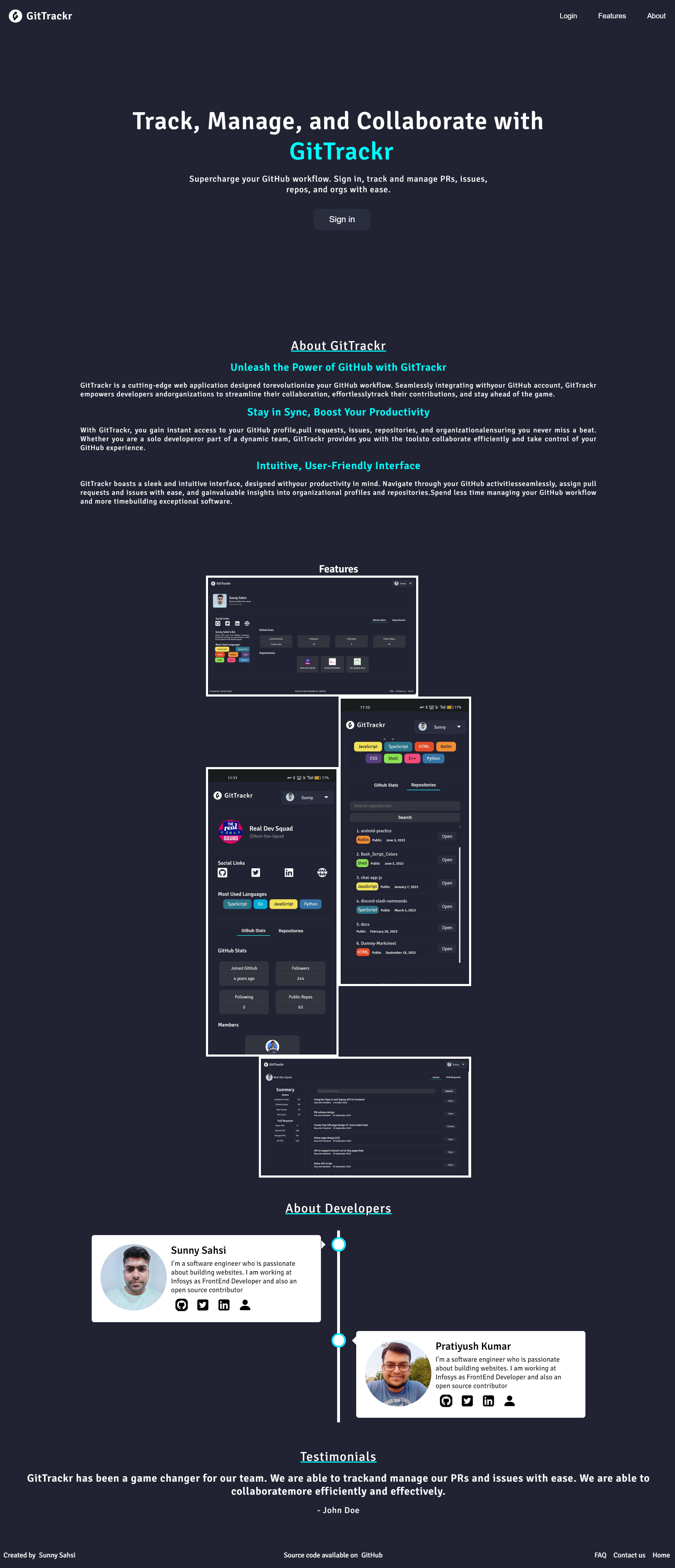
An engineering management dashboard that allows engineering teams and open-source organizations to monitor, triage, and manage GitHub issues, PRs, and contributor velocity.
Why this project was initiated
Built with Next.js, NextAuth, and React Query, GitTrackr connects to the GitHub REST and GraphQL APIs to provide unified multi-repo issue triage, pull request lifecycle tracking, team velocity summaries, and contributor activity graphs with Vitest test coverage.
Engineering Deliverables
Deep Dive: Engineering Multi-Repo GitHub Management Dashboard
GitTrackr is an engineering management and triage dashboard that connects to the GitHub REST and GraphQL APIs. It addresses the fragmentation problem engineering teams face when collaborating across dozens of microservice repositories, open-source organizations, and distributed PR review queues.
Architecture Topology
+-------------------------------------------------------------------------+
|                  Next.js App Router Client Dashboard                    |
|      • Multi-Repo Search & Label Filtering                              |
|      • Optimistic Triage & Issue Assignment                             |
|      • Real-Time Query Invalidation via React Query                     |
+------------------------------------+------------------------------------+
                                     |
                                     v
+-------------------------------------------------------------------------+
|                      Authentication & Session Layer                     |
|      • NextAuth.js with GitHub OAuth Provider                           |
|      • Granular Repository Access Token Scopes (read:org, repo)         |
|      • JWT Refresh Token Rotation                                       |
+------------------------------------+------------------------------------+
                                     |
                                     v
+-------------------------------------------------------------------------+
|                      GitHub GraphQL & REST Data Layer                   |
|      • Batching GraphQL queries to prevent API rate-limit exhaustion    |
|      • Cursor-based pagination across issue and pull request threads    |
|      • Automated Webhook Receivers for instant CI status reflection     |
+-------------------------------------------------------------------------+
1. GraphQL Batching & Rate-Limit Optimization
Querying 20+ active repositories via the standard REST API quickly exhausts GitHub's 5,000 requests/hour limit. GitTrackr bundles queries into composite GraphQL requests, retrieving repository statuses, open PRs, assigned reviewers, and CI build badges in a single round-trip:
export const ORG_TRIAGE_QUERY = `
  query GetOrgTriageStatus($org: String!, $cursor: String) {
    organization(login: $org) {
      repositories(first: 25, after: $cursor, orderBy: {field: PUSHED_AT, direction: DESC}) {
        nodes {
          name
          isPrivate
          openIssues: issues(states: OPEN) { totalCount }
          pullRequests(states: OPEN, first: 10) {
            nodes {
              number
              title
              author { login avatarUrl }
              reviewDecision
              updatedAt
            }
          }
        }
      }
    }
  }
`;
2. Optimistic UI Updates & Testing Rigor
Issue triage requires split-second responsiveness. When an engineering lead applies a label, assigns a contributor, or closes an issue: - React Query applies the mutation optimistically to the local cache immediately. - The background network request executes concurrently. - If the network call fails or experiences rate limits, the UI automatically rolls back with a toast notification. - The application is validated with automated Vitest test suites and React Testing Library tests covering every triage workflow.
Engineering Outcome & Takeaways
Shipping this project reinforced the value of clean architectural boundaries, automated verification loops, and clear error telemetry. In subsequent iterations, I focus on system observability, end-to-end integration test suites, and strict performance profiling under load.